
 Home
Theories of rapid learning, imagination and reasoning in brains and machines
by
Professor Surya Ganguli
Department of Applied Physics
Stanford University
348 via Pueblo
Stanford, CA 94305-5447
sganguli@stanford.edu
http://ganguli-gang.stanford.edu/˜surya.html
Date: Tuesday, January 20, 2026
Time: 16:00 Hrs.
Venue: ECSU Seminar Room
Electronics and Communication Sciences Unit
9th Floor, S. N. Bose Bhavan (Library Building)
Indian Statistical Institute
203 B T Road
Kolkata 700108
Abstract
Three remarkable abilities of brains and machines are to: (1) learn behaviors from a single example, (2) imagine new possibilities, and (3) perform mathematical reasoning. I will discuss analytic and predictive theories of how (1) neural networks in both monkeys and machines can learn new concepts from a single example; (2) how diffusion models can imagine new images despite being trained on a finite training set, and (3) how large language model training protocols can be modified so that they can better perform mathematical reasoning. Together this will cover a subset of how brains and machines can learn, imagine and reason.
References:
Few shot learning: https://www.pnas.org/doi/abs/10.1073/pnas.2200800119
Theory of creativity in diffusion models (ICML'25) https://arxiv.org/abs/2412.20292
Mathematical reasoning (NeurIPS '25) https://arxiv.org/abs/2502.07154
Biography:
Surya Ganguli is a professor of Applied Physics at Stanford, an Associate Director of Stanford’s Human Centered AI Institute, and a Venture Partner at General Catalyst. Dr. Ganguli triple majored in physics, mathematics, and EECS at MIT, completed a Masters in Pure Mathematics and a PhD in string theory at Berkeley, and a postdoc in theoretical neuroscience at UCSF. He has also been a visiting researcher at both Google and Meta AI and a Venture Partner at a16z. His research spans the fields of neuroscience, machine learning and physics, focusing on understanding and improving how both biological and artificial neural networks learn striking emergent computations. He has been awarded a Swartz-Fellowship in computational neuroscience, a Burroughs-Wellcome Career Award, a Terman Award, two NeurIPS Outstanding Paper Awards, a Sloan fellowship, a James S. McDonnell Foundation scholar award in human cognition, a McKnight Scholar award in Neuroscience, a Simons Investigator Award in the mathematical modeling of living systems, an NSF CAREER award, a Schmidt Science Polymath Award, and an AI2050 Senior Fellowship.
All are cordially invited.
Prof. Dipti Prasad Mukherjee
Electronics and Communication Sciences Unit
Indian Statistical Institute
203 B. T. Road
Kolkata 700108
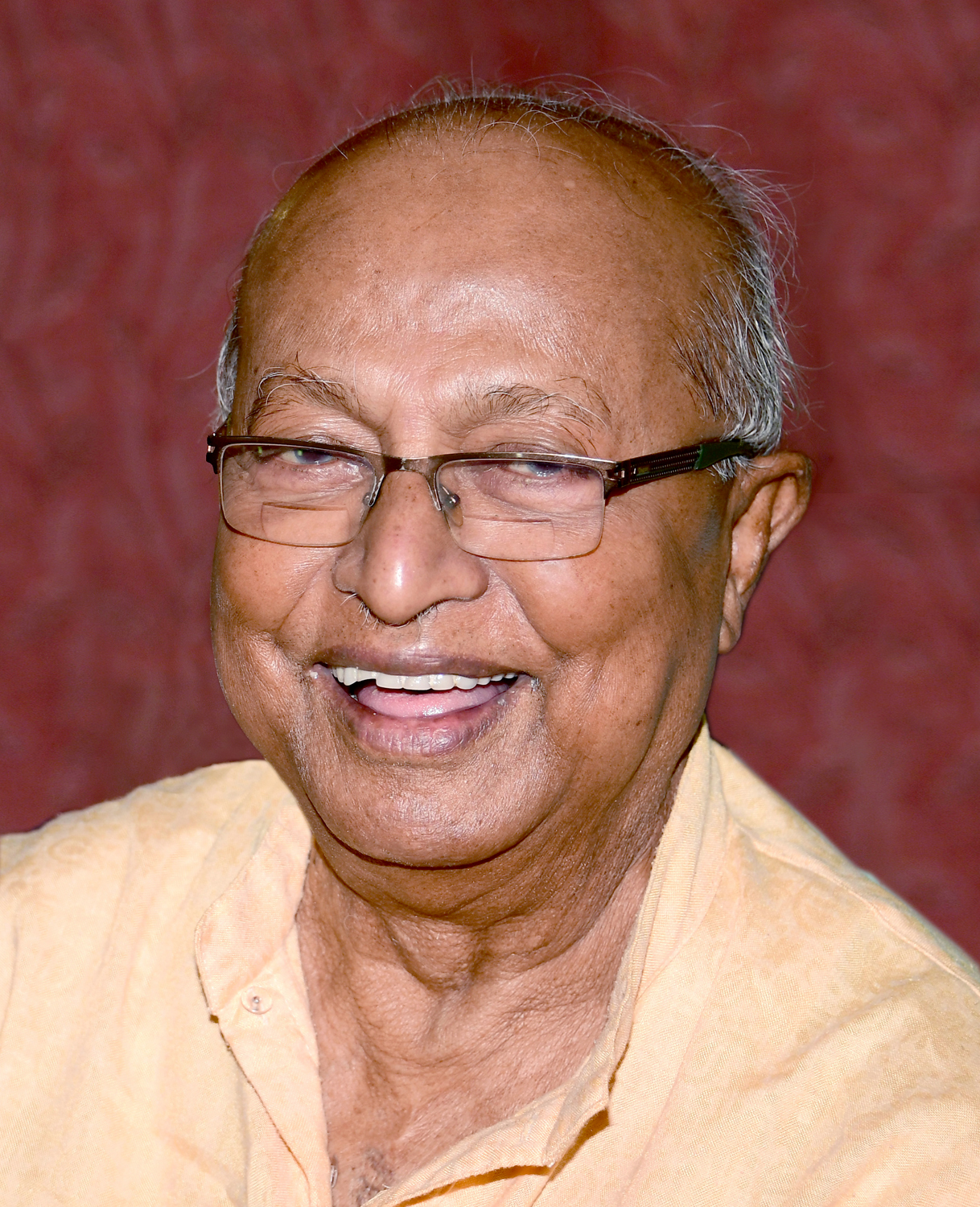
Prof. Dwijesh Dutta Majumder (10 Feb 1932 - 27 Jun 2020) Founder Head of ECSU