Why percentiles
The percentile of a student is the
percentage of fellow candidates receiving smaller score. The accompanying
figures show, for two Class XII Boards, the graphs of percentile of a student vs.
aggregate percentage score. Board A is CBSE (2012) and Board B is Maharashtra
Board (2012).
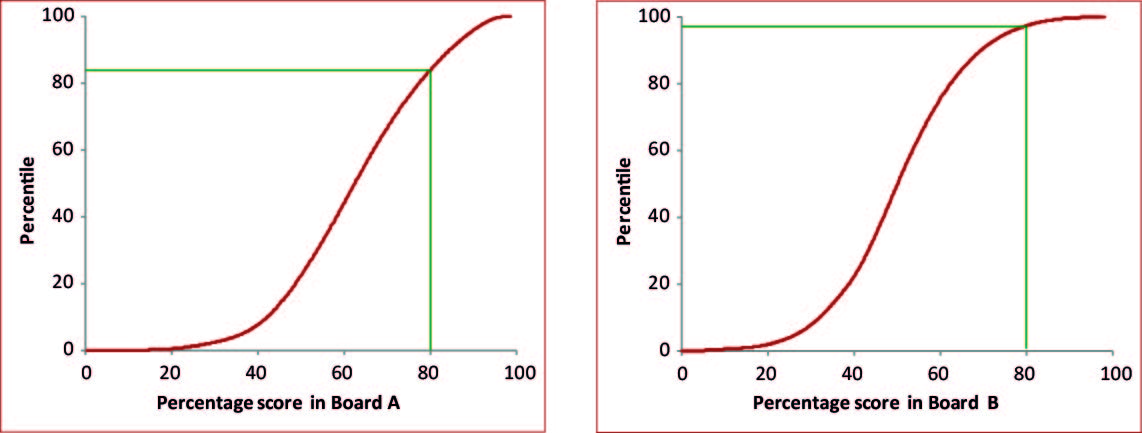
It is clear that the Board A
students generally received higher percentage of marks. For example, over 16%
of the Board A candidates received 80% or higher aggregate score, whereas less
than 3% of the students of Board B obtained aggregate scores in that range.
Comparison through percentiles is more even. Exactly 20% of the candidates of
either board would be at the 80th percentile or above.
Use of percentiles has several
advantages.
First, the underlying assumptions
are easily understood. One of the assumptions is that the Class XII scores of a
particular board are in the order of overall merit of the students of that
board. Another assumption is that students of all boards have the same
distribution of overall merit. The decision to utilize Class XII marks of
different boards, together with the fact that there is no reliable record of
relative merit distributions in different boards, makes it imperative to make some assumption about these merit
distributions, and the assumption of equal merit distribution is the simplest
and fairest that can be made under the circumstances.
Another advantage of relying on
percentiles is that it is difficult to manipulate at the institutional level.
As soon as it is known that board marks would be used for engineering
admissions, it is likely that there would be pressure on boards to award higher
marks. Percentiles remain largely immune to any distortion caused by awarding
higher marks.
A case in point is the dramatic
increase, from 2012 to 2013, in the number of CBSE students receiving 90% or
more marks. It is reported that this number has jumped by about 50%. If the
aggregate percentages had been used as such as normalized score, then this
increase would have benefited the CBSE students. However, when percentiles are
used, the fraction of students in any percentile range would be the same
irrespective of whether marking is liberal or otherwise.
The use of percentiles for
normalization should discourage boards to award excessively high (or low)
marks. If they do that, one end of the score range becomes crowded with the
scores of too many candidates. As a result, a very small difference in
aggregate scores can make a large difference in percentiles. Many
CBSE students have reportedly faced this situation in 2013.