
| Home |
|---|
| People |
| History |
| Monuments |
| Food |
| Photo Galary |
| Home | People | History | Monuments | Food | Photo Galary |
|---|
HISTORY
Before the arrival of the Portuguese in the mid 15'th century, there was no written history of West Africa. The historians were known as Griots who told the story their way. They relied mostly on memory to recite history of families, clans or tribes.
Hannon the Carthaginean had referred to the Gambia while writing about his voyage to West Africa in 470B.C. The river Gambia was known to the Carthaginean sailors in the 5'th century B.C.
Islam In The Gambia
The trade across the Sahara was carried out by Arab and Berber merchants from North West Africa. They were Muslims: they introduced their religion and Islamic culture into the places in West Africa where they traded . Muslim Berbers from Mauritania brought Islam to The Gambia and other areas south of Senegal. Many local. Rulers and elders were converted and introduced Islamic ideas and laws to their people.
The Portuguese:
The first Europeans to trade with Africans along the Atlantic coastline were from Portugal. They began trading with the people of the Gambia by 1456. They bought cloth, beads, mirrors and liquor to sell. They exchanged these for gold dust, hides, ivory and slaves. They built trading stations along the estuary of the River Gambia and on the banks of the Bintang Creek.
The Latvians: - James Island
A Latvian, Duke of Courland, was interested in the trade along The river Gambia. In 1651 the Duchy gained its first colony in Africa, St. Andrews Island up The Gambia River and established a fort there. The main export goods were ivory, gold, furs, spices. Soon, 1652, another colony was established in Tobago Island, British West Indies. Courland is the southern most province of modern day Latvia.
The English captured the fort in 1661 and the island bacame known as Fort James or James Island, after Jame Duke of York. This island is located west of Dog island up the River Gambia. The company used this fort as a trading base, first for gold and ivory then for slaves like Kunta Kinteh protraiyed in the movie "ROOTS" on the North bank of the river from Fort Jame is Jufureh . The governor of James island forced all foreign (non-English) ships entering the River Gambia to pay taxes on their goods.Ships that tried to evade the taxes were fired upon with canons.
In 1695, Fort James was taken by the French after a battle with the English sailors. It was returned in 1697 and then captured again in 1702.
The Abolition Of Slave Trade In The Gambia 1807 - 1816. On the 25'th March 1807, the Royal accent was given to a bill which prescribed that from January 1'st 1808 all manners of dealing and trading of Slaves in Africa or in their transportation from Africa to any other place was to be utterly abolished, prohibited and declared to be unlawful and enacted penalties for dealing in slaves. The act was promptly enforced by the British Navy as soon as it came into operation. The majority of British slavers found it impossible to escape the vigilance of British cruisers and thought a few bold spirits endeavored for a few years to risk the possibility of capture, the increased penalties prescribed by an amending act of 1811 more or less effectively put an end to British speculation mal practices in Slave Trade.
How The Gambia became a British colony
The Gambia was part of a large British colony known as the Province of Senegambia with covered present day Senegal and The Gambia. It's capital was St. Louis on the River Senegal. It was the first British colony in Africa. In 1779 the French captured the Senegal part of the region and the British agreed to base their trade around Bathurst and First James instead. In 1821, The Gambia became a Cron Colony attached to the British colony of Sierra Leone. In 1843, the parts of the Gambia ruled by Britain were again seperated from Sierra Leone. The rest of what is now called The Gambia. The Gambia became a British Protectorate in
The Gambia belonged to kingdoms which included the kingdoms of Foni, Kombo, Sine-Saloum, Niani, Wulli, and Fulladou. Some people had migrated to that area from various parts of West Africa. They traded with people from other kingdoms in the same region of West Africa. Some of these kingdoms were very important, the most important were Ghana, Sohnghai and Mali Empires (between the Atlantic Ocean and the River Niger) Kanen-Bornu and the Hausa States were also important. The Ghana empire was the earliest of these empires. It was the most important empire between 300 and 1000 A.D
Where It All Started - Trade With Europeans By 1500 A.D. , people in the area were also trading with Europeans. The first European to reach the River Gambia was Al Viso de Cadamosto, from Vernice, Italy.
The English: When the English traders heard about the Portuguese trade in Africa they wanted to participate. Their ships came to West Africa to buy gold and spices, but the Portuguese prevented them from coming to The Gambia. The English return to trade in the Gambia hundred years later at the end of the reign of Queen Elizabeth I(1558 - 1603).
The French: The French also built trade links with the West African coast. Sometime, their areas of trade overlapped and this led to conflicts. Fort James was seized as a result of a conflict by the French. The French bought a trading station at Alberada on the North bank of the River next to Jufureh. They signed trading treaties with the chiefs of the district.
The River Gambia had been recognized by the peace of Versailles in 1783 as a British possession and the abolition Act of 1807 therefore made slave traffic on the river illegal and unlawful. At that point, the majority of the British merchants and settlers on the river were concerned it may said that they accepted the decision from parliament and at once relinquished the traffic but difficulties arose with foreign slavers visiting the river. So long as Great Britain and France were at war, the French. Traffic on the river was precarious due to the risk of capture at high seas, but as late as 1810 a. French vessel managed to ship cargo of slaves at Sika near Albreda. The more extensive speculators. In the Traffic were however the Americans, Portugese and Spanish though the United States Government had passed an Act in 1807 which prohibited the further importation of slaves from abroad, a number of American citizens still continued to carry on the Trade under Spanish colors while such trader always ran the risk of capture by British cruisers near the "River's Mouth". The necessary limited number of ships patrolling the coast was insufficient to establish an effective blockade and foreign slavers were often to elude the vigilance of the British and to carry the cargoes safely across the Atlantic.
Archeological evidence in the form of stone axes and broken pottery points to the existence of early habitation in the Gambia River region around 2000 BC In 470 BC , Carthaginian sailors visited the River Gambia. Hannon the Carthaginian referred to The Gambia in his writings, making The Gambia known to the outside world. In AD300, West African trading networks expanded as early empires established trading networks for peoples living in the Gambia River area. Later kingdoms of the Foni, Kombo, Sine-Salom and Fulladou in The Gambia became trading partners of West Africa's great empires. Islam reached the Ghana Empire in the early 8th century, following the Arab conquest of North Africa.
Around AD 750, at Wassu, a large concentration of stone pillars was placed on the north bank of the River Gambia, the largest of which weigh about ten tons and stand about eight and a half feet above the ground. The stones likely mark the burial sites of kings and chiefs similar to burial grounds of royalty in the Ghana Empire. In the 11th century, Islamic leaders (Karamos) were buried like this, making some of the circles holy places.
Eastern Gambia was part of the great West African empires that flourished for a millennium beginning with Ghana after AD 300. The relative political stability guaranteed by the empires permitted trade and movement of peoples throughout the region. Powerful kingdoms organized as families and clans of Wolof, Mandingo, and Fulbe (Fulani) peoples formed larger social and political units. Small groups of Mandingos had settled in The Gambia by the 12th or 13th century, and a Mali-based Mandingo empire was dominant in the 13th and 14th centuries.
Portuguese sailors discovered the Gambia River in 1455; its navigability made it uniquely important for European traders seeking to penetrate the interior. In 1587, English merchants began to trade in the area. The Royal African Company acquired a charter in 1678 and established a fort on James Island, a small island in the river estuary. In 1765, the forts and settlements in The Gambia were placed under the control of the crown, and for the next 18 years The Gambia formed part of the British colony of Senegambia, with headquarters at Saint-Louis. In 1783, the greater part of Senegambia was handed back to France; the Gambia section ceased to be a British colony and was returned to the Royal African Company.
In 1816, Capt. Alexander Grant entered into a treaty with the chief of Kombo for the cession of Banjul Island. He renamed it St. Mary's Island and established on it a settlement that he called Bathurst (now Banjul). In 1821, the British settlements in The Gambia were placed under the administration of the government of Sierra Leone. This arrangement continued until 1888, except for the period 1843–66, when The Gambia had its own colonial administration. In 1888, The Gambia again became a separate colony. Its boundaries were defined following an agreement with France in 1889.
After 1888, The Gambia was administered by a governor assisted by an Executive Council and a Legislative Council. In 1902, St. Mary's Island was established as a crown colony, while the rest of the territory became a protectorate. In 1960, universal adult suffrage was introduced in the protectorate, and a 34-member House of Representatives replaced the Legislative Council. The office of prime minister was created in 1962, and the Executive Council was reconstituted to include the governor as chairman, the prime minister, and eight other ministers. Dr. (later Sir) Dawda Kairaba Jawara, the leader of the Progressive People's Party (PPP), became the first prime minister. The Gambia attained full internal self-government on 4 October 1963, with Jawara as prime minister. An independence constitution, which came into force in February 1965, established The Gambia as a constitutional monarchy within the Commonwealth.
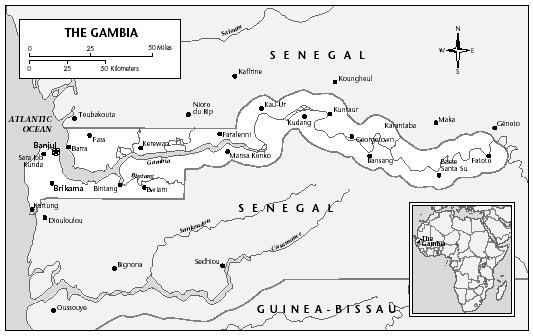
LOCATION: 13°10′ to 13°35′ 36″ N ; 13°43′ 5″ to 16°49′ 31″ W. BOUNDARY LENGTHS: Senegal, 756 kilometers (470 miles); Atlantic coastline, 71 kilometers (44 miles). TERRITORIAL SEA LIMIT: 12 miles.
On 23 April 1970, after a referendum, The Gambia became a republic with Jawara as the first president. He and the ruling PPP remained in power into the 1980s, weathering an attempted left-wing coup and paramilitary rebellion in July 1981, which was quashed by Senegalese troops under a mutual defense pact signed in 1965; an estimated 500–800 people died in the uprising, and there was much property damage. In February 1982, the Confederation of Senegambia was formally constituted. Jawara was reelected to a new term as president that May, receiving 72.4% of the vote. He was reelected in March 1987, defeating two opponents with 59.2% of the vote, and again in April, 1992. He gained 59% of the vote to 22% for Sheriff Mustapha Dibba, his nearest of four rivals. His PPP was also returned to legislative power but with a reduced majority. It fell from 31 to 25 of the elected seats, in the 36-seat House of Representatives.
| Copy right of Nasiru Deen & Cherno Talib Jallow |
|---|